
How to Win at Word Hunt: Tips and Strategy
By Word Hunt Solver · Published · Updated
Practical habits for finding more words, with two solved boards.
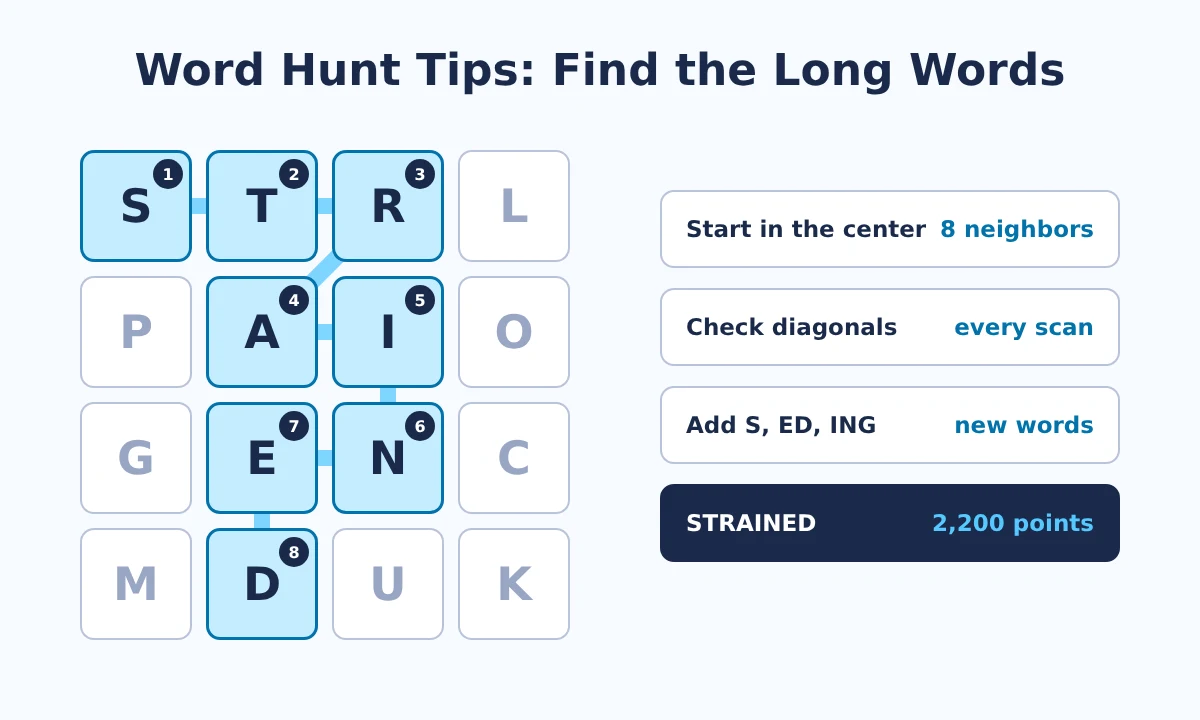
These Word Hunt tips come from the way the game actually scores. If you want to know how to get better at Word Hunt, start with how the game scores. This guide covers the scoring math, a scanning routine, ways to build longer words, and two real boards we solved, so every tip is backed by numbers. It works the same way whether you play on an iPhone or iPad, since GamePigeon runs inside iMessage on both.
Can You Win Word Hunt Every Time?
No. Your opponent might find more words, the board might favor their style, or you might just have an off round. What you can control is how many points you leave on the board. The tips below are about finding more of them, round after round.
Why Do Long Words Matter So Much in Word Hunt?
Word Hunt scores each word by its length, and the points jump fast as words get longer.
| Word length | Points | Same as this many 3 letter words |
|---|---|---|
| 3 letters | 100 | 1 |
| 4 letters | 400 | 4 |
| 5 letters | 800 | 8 |
| 6 letters | 1,400 | 14 |
| 7 letters | 1,800 | 18 |
| 8 letters | 2,200 | 22 |
A single 6 letter word earns more than a dozen 3 letter words. That doesn't mean you should skip short words. It means you should never stop looking for ways to make a word longer.
How Do You Scan a Word Hunt Board?
Scanning is how fast your eyes find paths, and it's the core of any good Word Hunt strategy. A steady routine beats staring at random spots.
Start From the Center Tiles
On a 4x4 board, each of the four center tiles touches 8 others, while a corner tile touches only 3. Words that pass through the center have the most ways to grow, so start there.
Check Every Direction, Including Diagonals
A word can bend up, down, sideways, or diagonally at every step, as long as each letter touches the one before it. Reading only left to right misses every word that runs another way. Trace diagonals on purpose until it becomes a habit.
Scan in Zones
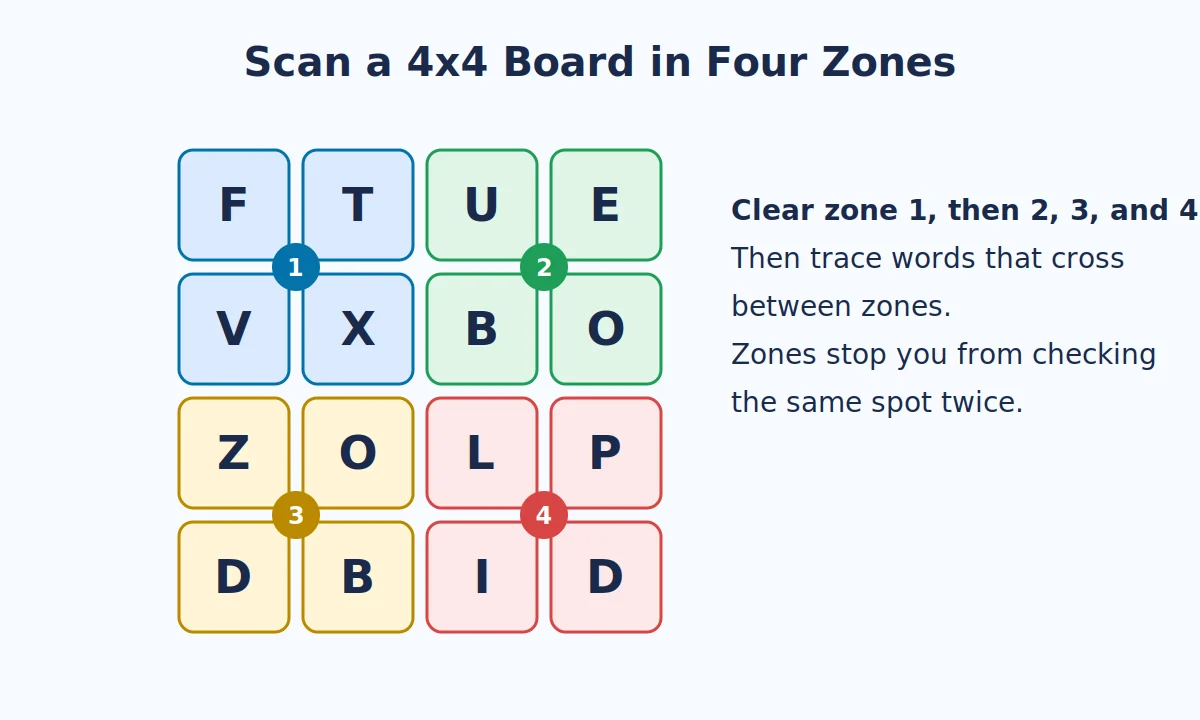
Split a 4x4 board into four corners of 4 tiles each. Clear one zone, then move to the next, then trace paths that cross between zones. Zones keep you from checking the same spot twice and missing another.
Match the Shape of a Path, Not Just the Letters
Once you know where a word sits, think of it as a shape, like an L or a zigzag. Swiping a shape is faster than hunting for each letter while the clock runs.
Which Letters Help You Most?
Every letter in Word Hunt scores the same, so a Q or a Z earns no more than an E. What matters is how many words a letter helps you build. Common letters like E, A, R, T, N, S, I, and O appear in many English words, so tiles with these letters are where most paths live.
Vowels are the glue. A consonant with two or three vowels around it can usually start several words. A cluster of consonants with no vowel nearby is often a dead end, so don't waste seconds there. Rare letters like Q, X, J, and Z can still help, as OUTBOX shows in the example below, but check them quickly and move on if nothing appears.
How Do You Find Longer Words?
Long words rarely jump out at you. You build them from words you've already found.
Build From a Base Word
When you find a short word, treat it as a starting point. Check every tile touching its first and last letters for letters that could extend it.
Add Prefixes and Suffixes
Try RE, UN, and DE before a base word, and S, ED, ER, and ING after it. Our Word Hunt cheat sheet lists more patterns. RAIN can become RAINS, RAINED, or TRAIN when the letters touch. Each version is a new word with its own points.
Follow Word Families
One good word often has relatives nearby. TONE can lead to TONES, TONED, and STONE if the letters connect. When you find a word with a family, check each relative before moving on.
Look for Smaller Words Inside Longer Ones
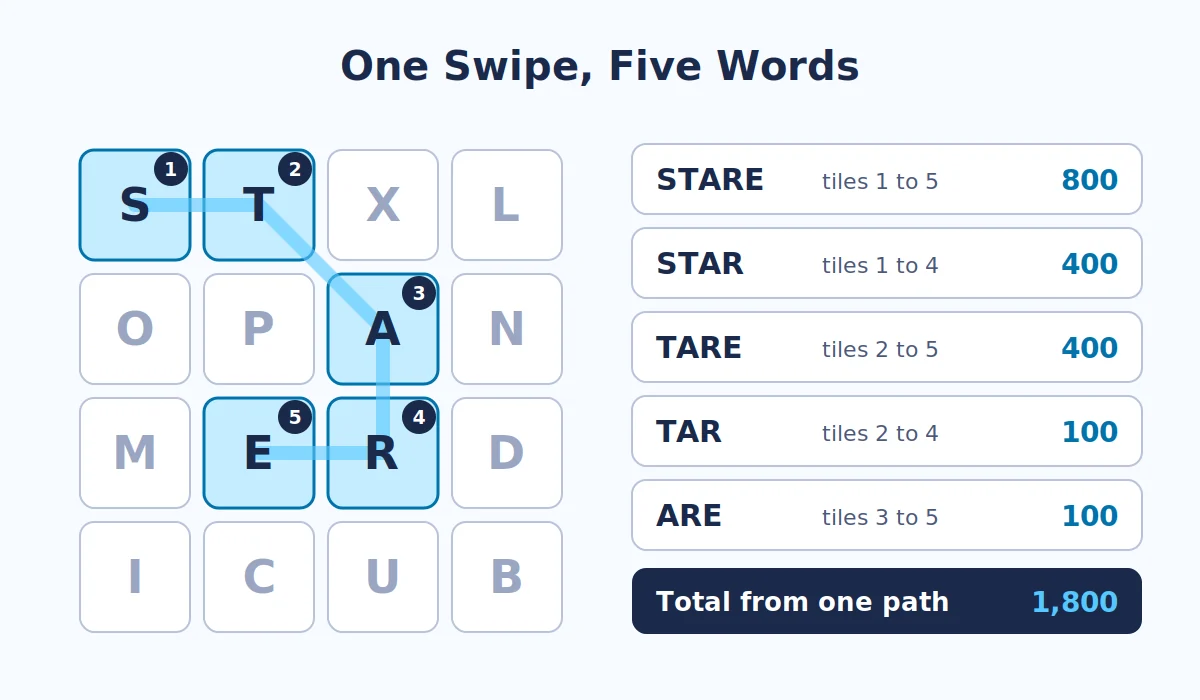
One swipe can hold several words. The path for STARE also holds STAR, TARE, TAR, and ARE.
A Worked Example: What One Board Really Holds
We ran this 4x4 board through our solver:
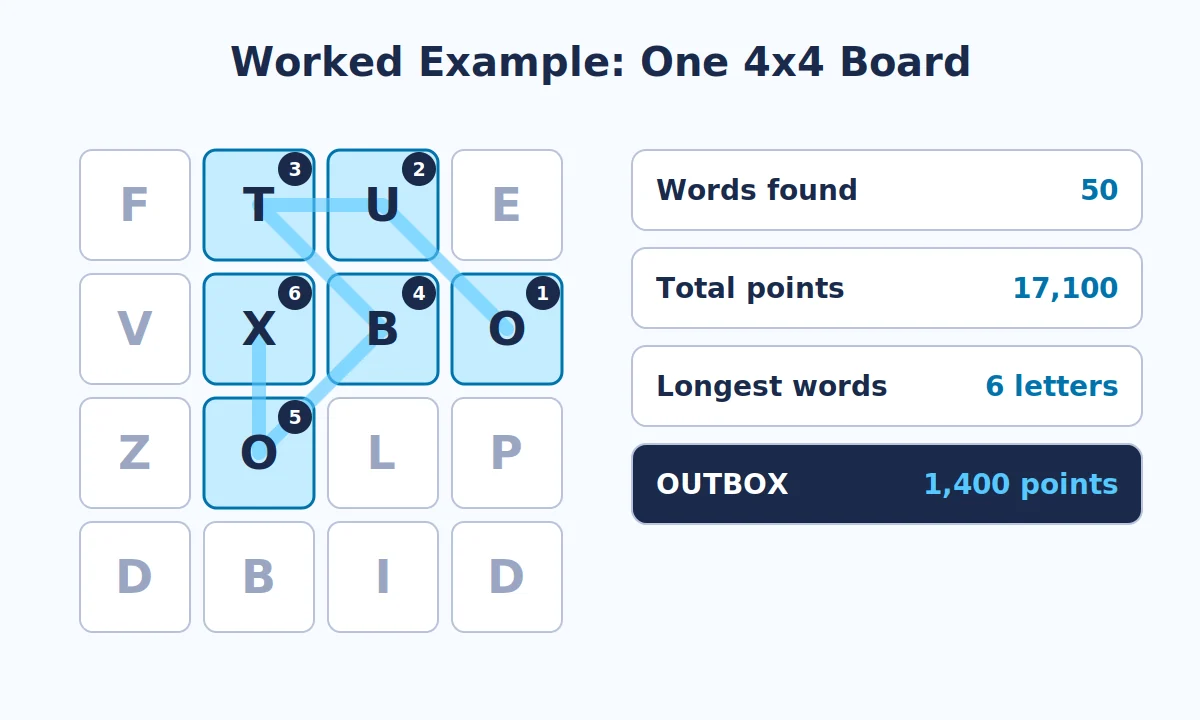
The solver found 50 words worth 17,100 points in total:
| Word length | Words found | Points |
|---|---|---|
| 3 letters | 25 | 2,500 |
| 4 letters | 18 | 7,200 |
| 5 letters | 4 | 3,200 |
| 6 letters | 3 | 4,200 |
Two things stand out. First, half the words are 3 letters long, but together they earn only about 15% of the points. Second, just 7 words of 5 or 6 letters earn 7,400 points, more than 40% of the total. The three 6 letter words are DIOBOL, DIPLOE, and OUTBOX.
OUTBOX shows how a long word bends. It starts on the O at the right end of the second row, moves up to U, left to T, down to B, down and to the left to the O in the third row, then up to X. Six letters, five turns, 1,400 points.
The 5 letter words are BILBO, OBOLI, OXLIP, and POLIO. Several of these are rare words. They're in the ENABLE list, but GamePigeon uses its own list, which isn't public, so we can't say whether the game accepts them. When you practice, start with the common words you'll recognize in real games.
We also ran a 5x5 board through the solver. It held 123 words worth 57,400 points, led by KYPHOSIS, an 8 letter word worth 2,200 points.
| Word length | Words found on the 5x5 board |
|---|---|
| 3 letters | 42 |
| 4 letters | 49 |
| 5 letters | 22 |
| 6 letters | 6 |
| 7 letters | 3 |
| 8 letters | 1 |
How to Scan This Board Step by Step
Start in the center, where X, B, O, and L sit. X is a rare letter, so check it quickly: it gives VOX, LOX, and BOX, then move on. The O, L, and B around it are where the points are. Work that cluster first, then move to the bottom row, where D, B, I, and D connect with the L and P above them to give LID, DIP, PLOD, and BOLD. Finish with the top row, where T, U, and E join the B and O below for TUBE, BOUT, and OUT.
The 4x4 board also shows how clusters work. The O, L, and B in the middle produce BLOB, LOBO, OBOL, POLO, BOLO, and LOB. Once you spot a cluster like that, stay with it until it runs dry.
What Quick Habits Help in a Short Round?
Not every one of these Word Hunt tips needs weeks of practice. These three habits work in your very next round.
Grab Easy 3 Letter Words Without Stopping Your Scan
Swipe short words as you see them, but keep your eyes moving. Short words keep your score climbing while you look for longer ones.
Try Plurals Right Away
After every word, check for an S touching its last letter. It takes a second and often adds a 4, 5, or 6 letter word.
Use the Last Seconds Well
When time is almost up, stop chasing long words. Swipe every short word and plural you can see. Quick 100 and 400 point words add up in the final seconds.
How Do You Practice Word Hunt Between Matches?
Review the Words You Missed
After a match, enter the same board in our free solver and compare its list with what you found. Write down one pattern you missed, like a suffix or a diagonal, and look for it next round.
Train on High Scoring Boards
Our Board Evolver builds high scoring practice boards. Practicing on boards packed with words gives you more clusters to spot in each session.
Set One Goal per Round
Pick a single focus, like trying a plural after every word or finding one 6 letter word. One clear goal is easier to build into a habit than five at once.
Practice With a Friend
After each match, open the same board in our solver together and compare who missed what. You'll both learn faster, and it keeps the game fair.
Track Your Scores
Write down your score after each match for a week. Seeing your average climb shows which habits are working, and a drop tells you which ones slipped.
Practice on 4x4 and 5x5 Boards
Each size has its own feel. A 5x5 board has more tiles to scan, so practice a steady route around the edges and through the middle.
What Mistakes Should You Avoid in Word Hunt?
The most common mistake is a broken path. Every letter has to touch the one before it, and you can't use the same tile twice in one word.
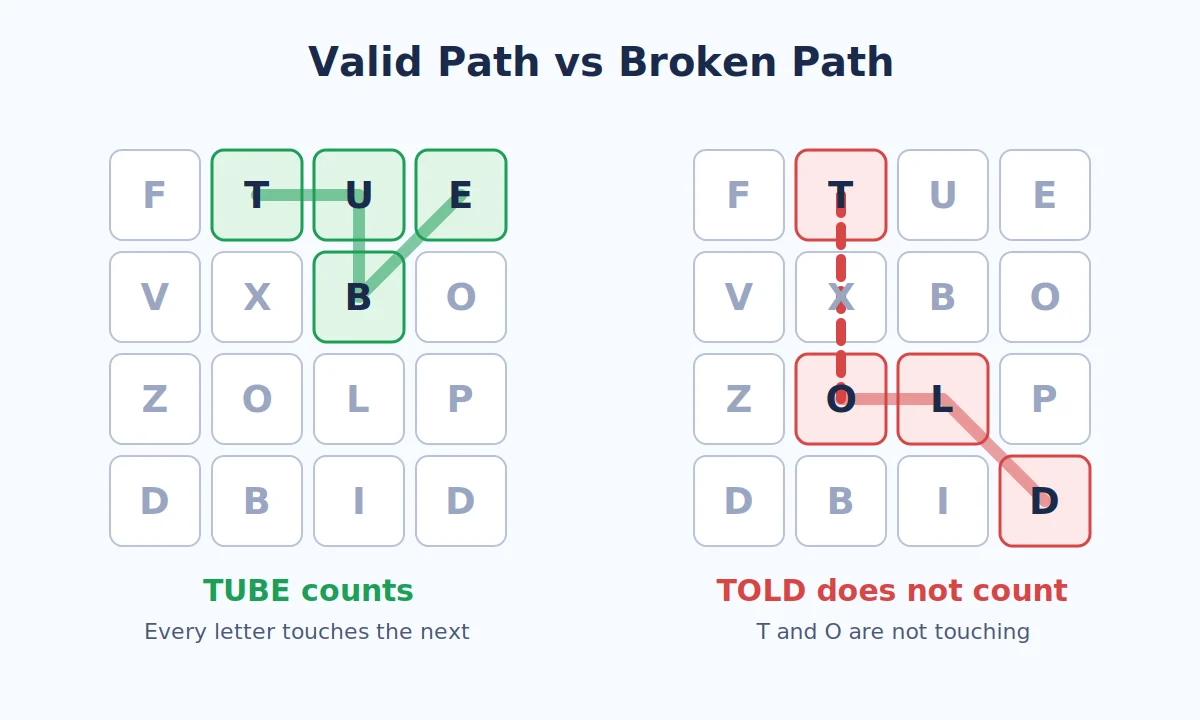
Other mistakes cost points too.
Chasing One Word Too Long
If a long word isn't coming together in a few seconds, move on. Ten short words are worth more than one long word you never finish.
Reading Only Left to Right
Words bend and run backward. If you only read like a book, you'll miss most of the board. Make yourself trace diagonals and reverse paths every round.
Sloppy Swipes
Lifting your finger one tile early or late turns a real word into a miss. Smooth, steady swipes beat frantic ones, especially on a crowded 5x5 board.
Frequently Asked Questions
QIs a 5x5 Board easier than a 4x4 Board?
A 5x5 board has 25 tiles instead of 16, so it usually holds more words. In our two demo boards, the 4x4 board held 50 words and the 5x5 board held 123. More words means more chances to score, but also more board to scan.
QHow do you beat someone who always wins?
Learning how to win at Word Hunt starts with long words. On our example board, just 7 longer words earned over 40% of the points. Then review each board you lose and learn one new pattern from it.
QWhy are some Word Hunt Boards harder than others?
The letters decide most of it. Boards with plenty of vowels and common letters like E, A, R, S, and T connect into many words. Boards with few vowels, or rare letters like Q, Z, and X, have fewer paths that spell anything.
QCan you find 100 Words on one Board?
Sometimes. It depends on the board size and its letters. Bigger boards have more paths, so 5x5 and 6x6 boards pass 100 words more often than 4x4 boards. To count the words on any board, enter it in our solver and check the Words Found total.
QDo Plurals count as new Words?
Yes, when the letters connect. STAR and STARS are two separate words, and each one scores on its own. That's why it pays to check for an S touching the last letter of every word you find.