
Word Hunt Cheat Guide: Fair Ways to Find More Words
By Word Hunt Solver · Updated
Learn when a solver is fair, how people cheat, and the letter patterns behind every word.
Is Using a Word Hunt Solver Cheating?
It depends on when you use it. A solver is fair when you use it to learn, and unfair when you use it to beat a friend who thinks you're playing on your own.
When Using a Solver Is Unfair
Word Hunt is a match between you and a friend in iMessage. If you look up words during that match and your friend doesn't know, you get help they don't have. That's cheating, even if it's only one round.
Fair Ways to Use a Solver
Use it after a round to see every word you missed. Use it on Board Evolver practice boards. Or agree with a friend that you'll both use one, which turns the match into a speed contest. In each case, everyone knows the rules.
How Do People Cheat at Word Hunt?
Most people searching how to cheat on Word Hunt want one of two things: a list of answers for their current board, or a tool that plays for them. Here's how each works and why neither helps you improve.
Looking Up Words Mid Round
Some players type their board into a solver while the round is running and copy the longest words. The catch is that rounds are short and timed, so time spent switching apps is time you're not swiping.
Why the Timer Makes Lookups Hard
Typing 16 letters, reading a results list, and then tracing each path takes real time. No word hunt hack removes that delay. Learning a few strong patterns lets you find words without leaving the game.
Auto Solvers and Bots
A Word Hunt auto solver is a program that reads the board from the screen and swipes words for you. Several hobby versions exist online. They take the game out of your hands, and you learn nothing from them. We don't build them or link to them.
Word Hunt Cheat Sheet: Letter Patterns to Look For
This cheat sheet works without any tool. Word Hunt only counts word length, so patterns that make words longer are worth learning first.
Common Prefixes
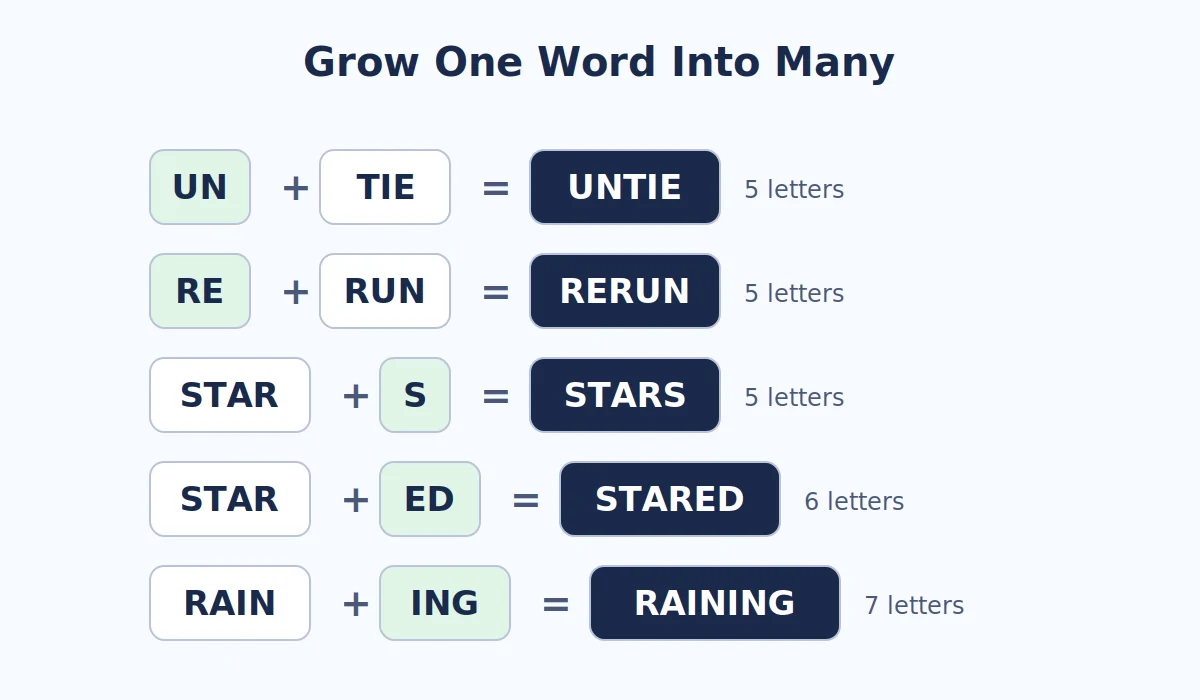
Look for RE, UN, DE, and PRE in front of a word you've found. TIE becomes UNTIE, and RUN becomes RERUN, when those letters touch the start of the path.
Common Suffixes
Check the end of each word for S, ED, ER, ING, and TION. One base word can turn into four or five longer ones. STAR can become STARS, STARE, STARED, and STARES.
Letter Pairs That Start Many Words
TH, ST, CH, and SH begin many English words. When you see two of these letters touching, start your scan there and follow the vowels next to them.
Patterns That Waste Your Time
Some spots on a board rarely pay off. A clump of consonants with no vowel touching it seldom makes a word. A Q with no U next to it usually leads nowhere in English. And a word with a double letter, like BOOK, needs two separate O tiles that touch, since you can't use one tile twice. Spot these fast and move on.
Words for Word Hunt: Short Words That Add Up
When people look for the best words for Word Hunt, short common words are a good place to start, since you can swipe them in a second. This isn't a full word hunt word list. These picks are checked against the ENABLE word list our solver uses, and they're built from common letters like E, A, R, T, N, S, O, and I.
Useful 3 Letter Words
ANT, ARE, ART, ATE, EAR, EAT, ERA, NET, ONE, ORE, RAN, RAT, SAT, SEA, SET, SIT, TAN, TAR, TEA, TEN, TIE, TIN, TOE, and TON.
Useful 4 Letter Words
EARN, EAST, NOTE, RAIN, RATE, RENT, REST, RIOT, ROSE, SEAT, SENT, STAR, TEAR, TIDE, TILE, TIME, TONE, TIRE, and TORE.
Useful 5 Letter Words
ALERT, ALTER, IRATE, NOTES, RAINS, RATES, SNARE, STARE, STONE, TEARS, TONES, and TRAIN. Notice how many of these are short words with one letter added. That's a pattern worth looking for.
Plurals and Word Endings
Every time you find a noun or verb, check for an S next to its last letter. TONE can become TONES, TONED, and STONE if the letters connect. Each new form counts as its own word.
Manual Word Hunting vs Using a Solver
| Hunting on your own | Using a solver | |
|---|---|---|
| Fair in a real match | Yes | Only if your friend agrees |
| Builds your skill | Yes | Yes, if you review the results after a round |
| Finds every word | No | Yes, every word in its word list |
| Works under time pressure | Yes | Slow to switch back and forth |
You can use both: play on your own, then check the board afterward.
How to Find More Words Without a Solver
Start in the center of the board, where each tile has the most neighbors. Grab every 3 letter word you see without stopping. Then go back to your best base words and try adding letters to the front and back. Our Word Hunt strategy guide covers this in depth.
Frequently Asked Questions
QDo Cheat Sheets work on 5x5 Boards?
Yes. The same prefixes, suffixes, and short words work on any size. A 5x5 board has 25 tiles instead of 16, so there are more paths and usually more words to find.
QWill the Game accept every Word on this List?
Not always. Our lists come from the ENABLE word list, and GamePigeon's word list is a different one that hasn't been made public. Because that list isn't public, we can't say which words it leaves out.
QWhat is the best Word in Word Hunt?
There isn't one best word, because every board is different. The best word on any board is the longest one you can swipe, since Word Hunt scores by length. One 8 letter word earns 2,200 points, as much as twenty two 3 letter words.
QAre there Word Hunt Answers for every Level?
No. Word Hunt doesn't have numbered levels with fixed answers. Each match gives you a new letter grid, so no answer list covers every board. To see the words on the board in front of you, enter it in our free solver after the round.
QIs there a Word Hunt Hack that works every Time?
We don't know of any hack that changes the board, the timer, or the scoring. Every method that works comes down to finding more and longer words. Learning the prefixes, suffixes, and letter pairs on this page is the fair way to do that.