
Word Hunt Solver vs Word Finder vs Word Search Solver: What's the Difference?
By Word Hunt Solver · Published · Updated
Three word tools sound alike but solve very different puzzles. Here's what each one does, which puzzle it fits, and why the wrong tool gives you useless answers.
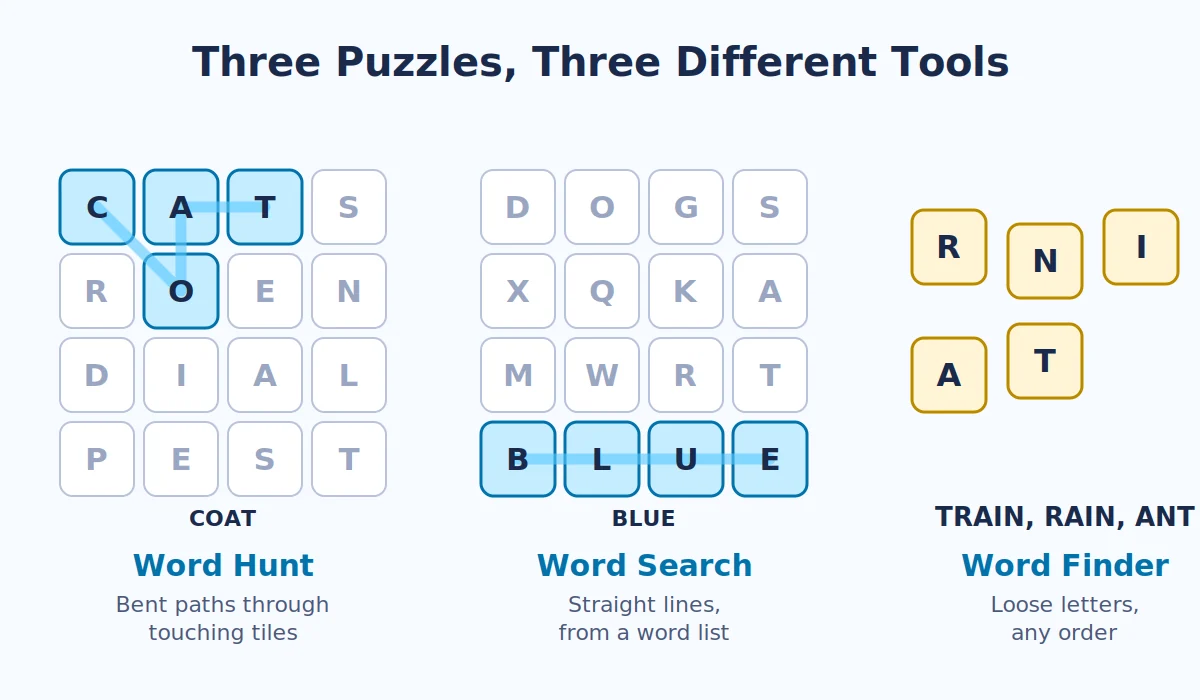
Is Word Hunt the Same as a Word Search?
No. In a word search, the puzzle gives you a list of hidden words, and each one runs in a straight line across the grid. In Word Hunt, the GamePigeon game played in iMessage, there's no list. You find any words you can, and each word can bend in any direction as long as every letter touches the one before it.
The names cause real confusion. Many puzzle sites title their word search puzzles "Word Hunt," so a search for word hunt vs word search often turns up both kinds of puzzle.
How to Tell Which Puzzle You Have
Ask three questions. Did the puzzle come with a list of words to find? Do the words run only in straight lines? Is it printed or in a puzzle book? If the answer is yes, it's a word search. If you're racing a friend in iMessage with no list, it's Word Hunt.
What Is a Word Search Solver?
A word search solver finds the listed words in a word search grid. It checks every row, column, and diagonal, forward and backward, because that's how those words are hidden. Some of these tools let you snap a photo of a printed puzzle. Since it only follows straight lines, it can't find bent paths, so it misses most Word Hunt words.
What Is a Word Finder?
This tool takes a set of loose letters and shows the words you can make with these letters in any order. Finding words from letters this way works for games like Scrabble, where your letters sit on a rack, not in a grid. A word finder from letters ignores position completely.
How Unscramblers and Anagram Solvers Differ
These tools are close cousins. A scrambled word solver, also called a jumble word solver, takes jumbled words and finds the real word hidden inside. An anagram solver finds every word that uses all of your letters, like turning LISTEN into SILENT. The finder itself lists every word you can make with some or all of the letters. People sometimes search for a word hunt anagram solver, but anagram tools can't follow a grid path.
Can a Word Hunt Solver Solve a Word Search Puzzle?
Not well. A grid path solver lists every word that can be traced through touching tiles, including words that bend. A word search puzzle only hides words in straight lines, and only the words on its list. The solver would show hundreds of words your puzzle doesn't ask for.
Can a Word Finder Solve a Word Hunt Board?
No. If you type a Word Hunt board into a letters only tool and try to unscramble Word Hunt letters, it treats them as loose letters. It will suggest words that use letters from opposite corners of the board, which you can't swipe in the game. A Word Hunt word only counts if its path connects, so you need a tool that knows where every letter sits. That's what our homepage solver does.
Here's a real case. On the 4x4 board in our worked example, every letter of PILOT and VIDEO is on the board, so a letters only tool would suggest both. Neither can be swiped, because their letters don't connect in order.
Is Word Hunt the Same as Boggle?
Word Hunt plays a lot like Boggle. Both use a letter grid, both let words bend through touching letters in any direction, and both forbid using the same tile twice in one word. The scoring is different. Classic Boggle gives 1 point for 3 and 4 letter words and up to 11 points for 8 letters or more. Word Hunt gives 100 points for a 3 letter word, up to 2,200 for an 8 letter word. Boggle is also played with real letter dice, including a Qu cube, while Word Hunt is played on your phone. Because the paths work the same way, a Boggle word hunt solver finds the same kinds of words as a Word Hunt one, though Boggle tools may also handle the Qu cube.
Which Tool Should You Use?
| Your puzzle | How the letters connect | The right tool |
|---|---|---|
| GamePigeon Word Hunt | Touching tiles, any direction | Word Hunt solver |
| Boggle | Touching dice, any direction | Boggle or grid path solver |
| Printed or app word search | Straight lines only, with a word list | Word search solver |
| Scrabble rack or loose letters | Any order, no grid | Letter based finder |
| Jumbled word puzzle | All letters, rearranged | Unscrambler or anagram solver |
Why Does Using the Right Tool Matter?
The wrong tool doesn't just waste time. It gives you answers that look right but fail in the game. A letters only tool can hand you a long word you can't swipe, and a straight line tool can miss the bent words that score the most in Word Hunt. Matching the tool to the puzzle means every answer you see is one you can actually use.
How Do You Solve a Word Search Faster?
Start with the rarest letters in each word on the list, like Q, Z, X, or J, since they appear in fewer spots on the grid. Scan one row at a time, then each column, then each diagonal. Look for double letters, like the two Ls in BALLOON, which can be easier to spot. These habits are how to solve a word search without a tool, and they work on most word puzzles that use straight lines.
Frequently Asked Questions
QIs Word Hunt the same as Anagrams on GamePigeon?
No. Anagrams is a different GamePigeon game. It gives you a small set of letters, and you make words by rearranging them in any order. Word Hunt gives you a grid, and each word must follow touching tiles. That's why an anagram solver can't solve a Word Hunt board.
QIs Word Hunt the same as Word Bites?
No. Word Bites is another GamePigeon word game. You move letter blocks around the board to build words that read across or down. In Word Hunt, the letters stay in place and you swipe through touching tiles.
QIs there a Word Search Solver that works from a Picture?
Yes. Some word search solvers can read a photo or screenshot of the puzzle. Our solver reads Word Hunt screenshots, not word search puzzles, because it looks for touching tiles instead of straight lines.
QHow do you solve Word Puzzles?
Start by working out which kind of puzzle you have. If words follow touching tiles in a grid, use a grid path solver. If words run in straight lines from a list, use a word search solver. If you have loose letters to rearrange, use a word finder or unscrambler. The tool table above matches each puzzle to its tool.
QCan a Word Search Solver work without a Word List?
Yes. Without a list, it checks every straight line in the grid against a dictionary and shows each word it finds. Expect extra short words that your puzzle never asked for.